
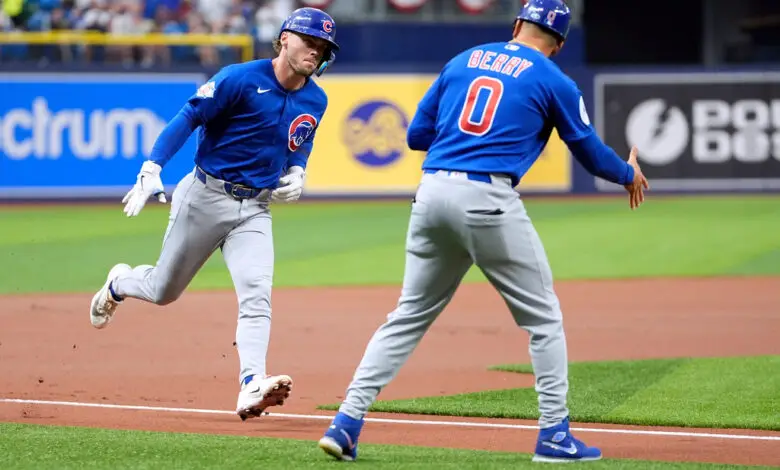
Nico Hoerner Assumes Full-Time Leadoff Role, Bolsters MVP Case with Leadoff Homer

It’s always nice to see when our collective manifesting — which might be a euphemism for whining — spurs the Cubs to take action, like trading for Kyle Tucker and Edward Cabrera. Except that a lot of folks will remain upset about the cost of those transactions for years to come, so maybe we should find a better example. How about Craig Counsell moving Nico Hoerner into the leadoff spot regardless of who is on the bump for the opponents?
Hoerner got only 75 plate appearances in the leadoff spot last season, none prior to July 11 and just 25 with a right-handed pitcher on the mound. But even that is a little misleading because 22 of those PAs against righties came after a lefty starter had been removed. In total, Hoerner hit leadoff against one righty starter last season: Bryce Elder of the Braves on September 3 at Wrigley. And that’s mainly because Elder was pitching to massive reverse splits.
Michael Busch held the leadoff spot most often against righties, with him and Hoerner splitting time there after Ian Happ was moved out of the role after July 10. Counsell had been doing more of the same with Hoerner and Busch until recently, with the former batting first against righties Mason Englert and Joe Boyle in the Cubs’ wins in Tampa. Prior to that, Hoerner had been batting fifth with a right-hander on the mound to start the game.
Is it a coincidence that the Cubs just won two games in a row for the first time this season and that Hoerner hit his first homer of the season on Boyle’s sixth pitch of the game? Probably. But it’s not just dumb luck that putting your best pure hitter at the top of the lineup on a daily basis is going to yield good results over the course of the season. As much as I understand playing the matchups and going with advantageous splits, I also see the value in continuity.
So while Busch is about 28% better at creating runs against righties (127 to 99 wRC+), the two actually have identical .336 career on-base percentages in those matchups. Factor in Hoerner’s far superior baserunning and Busch’s far superior power, and it becomes a lay-down case in the second baseman’s favor. And while it’s far too early to be considered sustainable, Hoerner’s 15.1% walk rate so far is well over double his career mark.
The same could be said for his MLB-leading 1.0 fWAR, which extrapolates to nearly 12.3 over a full season. That would tie him with Babe Ruth in 1924 for eighth all-time, right between Lou Gehrig in 1927 (12.4) and Rogers Hornsby in 1924 (12.2). Aaron Judge is the only player in the last 20 years to eclipse 11 fWAR, doing it in both 2022 and ’24, and Barry Bonds is the only player since Ruth in ’27 to be in the all-time top 10.
Bonds posted 11.9 fWAR in 2004, 12.5 in ’01, and 12.7 in ’02, good for 10th, sixth, and fifth on the list of MLB’s most productive seasons.
Hoerner, of course, is a very different animal. His game is much more closely related to Ty Cobb, Honus Wagner, or Tris Speaker, the only players to put up top-56 seasons with 10 or fewer homers. Most of the best seasons feature more homers than Hoerner’s career total of 37 over nearly 3,000 plate appearances, but few — maybe none — were accomplished in as understated a manner as the newly minted nine-figure man goes about his business.
The horse is probably out of the barn by now, but I was hoping we were all on the same page from the start that this whole thing is seasoned with a dash or two of hyperbole. It’s highly unlikely that Hoerner will see his name among the likes of Ruth, Bonds, Judge, and Cobb by the time the season ends. What he will see, however, is his name being mentioned more frequently among the greats of today’s game. Not long ago, he couldn’t even crack the top 100 in MLB Network’s asinine rankings of current players.
His lack of power is a big part of that, but I would argue that nearly 60% of his career PAs coming in the bottom of the lineup hurts the perception of him by those who aren’t paying close attention. So while Counsell’s decision to bat Hoerner at the top of the order every game isn’t about doing his player a solid, it could aid the way he’s viewed as much as it helps the Cubs. The same is true for ending Busch’s timeshare at first and letting him face southpaws more often.
Busch has already seen 15 PAs against lefties after getting 95 all of last year, which works out to about twice as often on a percentage basis. Being mostly a platoon hitter may have doomed Busch in Silver Slugger voting, as he was not even nominated despite having better numbers than nearly every one of his colleagues. His 140 wRC+ was one point behind Pete Alonso for the highest among first basemen, and his 34 homers also trailed only Alonso (38). Freddie Freeman‘s .370 wOBA barely surpassed Busch (.369) for tops at the position. Busch’s .523 slugging percentage was 13th best in all of MLB and just a point behind Alonso.
Moving Hoerner to leadoff permanently and using Busch as the everyday first baseman, regardless of the opposing pitcher, should yield more consistent play and greater accolades for the individual players.


